
PreWrathRapture.Com
  • Home
  • About
    • About PR.COM
    • What is Prewrath
  • Media
    • Blog
    • YouTube
    • Audio
    • Joining our Zoom Meetings
  • PreWrath Timeline
  • contact
  • Español
  • Store
  • Hermeneutics
  • Home
  • About
    • About PR.COM
    • What is Prewrath
  • Media
    • Blog
    • YouTube
    • Audio
    • Joining our Zoom Meetings
  • PreWrath Timeline
  • contact
  • Español
  • Store
  • Hermeneutics
PreWrathRapture.Com
Daniel

Daniel 2 and Daniel 7: Equal or Not Equal (Part 1)

by Charles Cooper February 16, 2010
written by Charles Cooper

Daniel 2 and Daniel 7 – Equal or not Equal Part 1.pdf

February 16, 2010 0 comment
0 FacebookTwitterPinterestEmail
Church HistoryPretribulationism

How Not To Do Church History: Taking John Calvin Out of Context

by Alan Kurschner February 14, 2010
written by Alan Kurschner

Pretribulational John Walvoord writes:

John Calvin, the great reformer, likewise looked for the imminent return of Christ. In commenting on 1 John 2:18, Calvin writes, “But the Apostle not only fortifies the faithful, lest they should falter, but turns the whole to a contrary purpose; for he reminds them that the last time had already come, . . . In the same way it behoves us to comfort ourselves at this day, and to see by faith the near advent of Christ, . . . nothing more now remained but that Christ should appear for the redemption of the world.” Even though Calvin did not follow premillennial truth, he nevertheless did believe in the imminency of the Lord’s return” (“Christ’s Olivet Discourse on the Time of the End: How Near is the Lord’s Return?,” p. 81, Bibliotheca Sacra, January 1972, John F. Walvoord).

What Walvoord fails to tell the reader is that Calvin believed in the imminent return of Christ, not because he thought the Church was raptured before Antichrist, rather Calvin believed the Antichrist was the papacy—hence, the reason Calvin believed that Christ could come back at any moment.
Here is the context of what Calvin continued to say in his commentary of 1 John 2:18, which was left out by Walvoord:

As ye have heard that antichrist will come. He speaks as of a thing well known. We may hence conclude that the faithful had been taught and warned from the beginning respecting the future disorder of the Church, in order that they might, carefully keep themselves in the faith they professed, and also instruct posterity in the duty of watchfulness. For it was God’s will that his Church should be thus tried, lest any one knowingly and willingly should be deceived, and that there might be no excuse for ignorance. But we see that almost the whole world has been miserably deceived, as though not a word had been said about Antichrist.

Moreover, under the Papacy there is nothing more notorious and common than the future coming of Antichrist [i.e., they did not recognize that he was already present]; and yet they are so stupid, that they perceive not that his tyranny is exercised over them. Indeed, the same thing happens altogether to them as to the Jews; for though they hold the promises respecting the Messiah, they are yet further away from Christ than if they had never heard his name; for the imaginary Messiah, whom they have invented for themselves, turns them wholly aside from the Son of God; and were any one to shew Christ to them from the Law and the Prophets, he would only spend his labor in vain. The Popes have imagined an Antichrist, who for three years and a half is to harass the Church. All the marks by which the Spirit of God has pointed out Antichrist, clearly appear in the Pope; but the triennial Antichrist lays fast hold on the foolish Papists, so that seeing they do not see. Let us then remember, that Antichrist has not only been announced by the Spirit of God, but that also the marks by which he may be distinguished have been mentioned.

This is consistent with the Prewrath position. When Antichrist appears and persecutes the Church, then Christ’s Return will be imminent! (but prewrath does not believe the pope is the Antichrist).
February 14, 2010 0 comment
0 FacebookTwitterPinterestEmail
Historicism

Εὐθέως (Immediately) in Matthew 24:29 Undermines Historicism

by Alan Kurschner January 27, 2010
written by Alan Kurschner

“Immediately after the tribulation of those days the sun will be darkened, and the moon will not give its light, and the stars will fall from heaven, and the powers of the heavens will be shaken.” (Matt 24:29).

Historicism is the eschatological position that says the thrust of prophecy in the Olivet Discourse and Revelation are fulfilled in the span of the church age. So for example, they would say that the Great Tribulation was not fulfilled in the first century, nor is it to be fulfilled in the future. Instead, it spans the entire church age.
You may by surprised to learn that most Evangelical scholars are not preterists or futurists—they are historicists. But many are a mixture of preterist-historicist. Or, more inconsistently, some are preterist-historicist-futurist.
There are good reasons why historicism is not a valid interpretation. I want to point out one salient reason here. In Matthew’s account of the Olivet discourse in Matthew 24:29 he uses the Greek term έὐθέως, which means “immediately.” The event that follows the “tribulation (i.e. great tribulation) of those days” is the coming of Christ. Matthew says that the coming of Christ will occur immediately after the tribulation of those days. What is the nature of this tribulation? We are told specifically that this tribulation is caused by the abomination of desolation (Cf. Matt. 24:15, 21).
So historicism cannot be correct for two reasons:
i. The tribulation will come about by the abomination of desolation. So this tribulation cannot be described as occurring over the span of the church age. That is, believers are not going through tribulation today because the Roman general Titus destroyed the Jewish temple in A.D. 70.
ii. Since historicism believes that the abomination of desolation in Matthew 24 was fulfilled in A.D. 70 with the destruction of the temple followed by tribulation, έὐθέως (immediately) must refer specifically to that tribulation, since the term has a temporal meaning requiring that the coming of Christ to occur in the first century. In other words, it is nonsense for them to claim as they do that “immediately” will happen thousands of years later after the abomination of desolation. Therefore historicism has a strained interpretation.
Prewrath has the natural reading. We understand that the abomination of desolation for Matthew refers to a futurist event of Antichrist in the temple. That will cause a great tribulation and immediately after those days are cut short the coming of Christ will happen.

January 27, 2010 0 comment
0 FacebookTwitterPinterestEmail
Hermeneutics

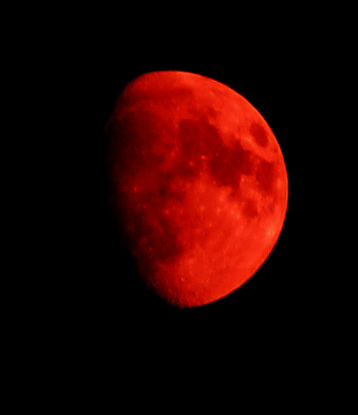
The Blood Red Moon:
Hyper Literalism vs. the Natural Reading

by Alan Kurschner January 20, 2010
written by Alan Kurschner

red_moon.jpg
Many Pretribulationists do not identify the sixth seal cosmic disturbances with the cosmic disturbances associated with the Lord’s Return in Matthew 24.
The most common reason I have heard is that Revelation states that the moon becomes a “blood red” color but in Matthew 24 it states that the moon does “not give its light.” Therefore, according to them, these are two completely separate events.

“the sun became as black as sackcloth made of hair, and the full moon became blood red” (Rev 6:12).

“the sun will be darkened, and the moon will not give its light” (Matt 24:29).

This is a classic case of hyper literalism interpretation. Can you imagine if we applied such wooden principles to the gospels? For example, the story of Jesus calming the storm has Matthew’s account with Jesus saying, O men of little faith; Mark has Have you no faith?; Luke has Where is your faith? According to their logic, Jesus must have calmed the storm three different times. Many more examples could be adduced from the gospel writers having the inspired freedom to use their own expressions and paraphrases.
Writers had the literary freedom to express vivid images about monumental significance. It is naive to pit the parallelism between John and Jesus simply because John adds the element about the diminish light from a red moon and Jesus simply states the fact of a diminished light.
The same can be said about the description of the sun:

Jesus: “the sun will be darkened”
John: “the sun became as black as sackcloth made of hair“

Are we suppose to believe that by necessity Jesus and John are talking about two different events because John augments his imagery? Of course not.
And what about that little important thing called . . . context. Never mind the fact that this celestial sign takes place when Jesus says that the elect are gathered at the Great Tribulation (Matt. 24:21-22, 29-31), and consistently John says the same thing (Rev 7:14). Is that a coincidence? The burden of proof is on them to show that. As for me, I am going with the natural reading.

January 20, 2010 0 comment
0 FacebookTwitterPinterestEmail
Mail Bag

INBOX: An Alternative to a Prewrath Study Bible

by Alan Kurschner January 20, 2010
written by Alan Kurschner

Alan – I would like to know if there are any study Bibles with pre-wrath notes? All the study Bibles I have contain pre-trib notes.
Thanks,
Judy

No there isn’t. However, there is an alternative. Photocopy the Scripture Indexes from prewrath books of Rosenthal, VanKampen, Cooper, et al., then place those pages in the back of your Bible, or near your Bible, for reference.

January 20, 2010 0 comment
0 FacebookTwitterPinterestEmail
Newer Posts
Older Posts

Search

Recent Posts

  • Elements of Bible Study

    July 28, 2021
  • Exegetical Gymnastics: The Tortious Interpretive Method of Pretribbers

    May 19, 2020
  • Digital Based PreWrath Gatherings!

    April 25, 2020

Categories


Enter Email for Blog Updates


Resources

International Prewrath

  • Chinese
  • Dutch
  • Spanish
  • Facebook
  • RSS

@2019 - All Right Reserved. Designed and Developed by PenciDesign


Back To Top