
Charles Cooper
A question often asked of us at Sola Scriptura is, “With so many important subjects in the Word of God, why should I study end-time prophecy? Won’t God work it all out in His own way and in His own time? Aren’t there more important issues to discuss?” These are good questions, and every believer should be able to answer them. We agree that the return of Christ is not the most important doctrine of the Christian faith. However, it is often a doctrine that is misunderstood or simply ignored.
Here are some points to be considered as to why we must study and understand biblical prophecy:
1. The return of Christ is the blessed hope of every believer (Titus 2:13). It behooves us to understand what will happen when Christ returns.
2. We must be prepared as the plan of God unfolds. We may be that generation upon which the end times fall. We must be ready and prepared.
3. We should study the entire truth of God’s word. Prophecy is part of God’s Word. Approximately 25% of Scripture is prophetic or predictive in nature. If we ignore prophecy, we are ignoring an important part of God’s word, and we should study “the whole counsel of God.”
4. We do not want to be deceived. Jesus warned His disciples that in the last days there would be many false messiahs and false prophets, some of whom would even do great wonders to deceive people (Matt. 24:4-5, 23-26). The apostle Paul warned the Thessalonian believers to not be deceived about the Lord’s return (2 Thess. 2:1-3). By studying and understanding Biblical prophecy we will guard ourselves from error and deception.
5. The consummation of God’s plan is the great goal of the Church. Like the faithful Abraham, we are “looking for the city which has foundations whose architect and builder is God” (Heb. 11:9-10). As Paul taught the Corinthians, this life is but a shadow, but the resurrection and the life to come is our great hope (1 Cor. 15:12-28).
6. The study of prophecy provides an anchor for our faith. Our faith will be revitalized as we see the fulfillment of prophecy in the past and it will encourage us to believe that God will also fulfill His promises that are yet future.
7. We demonstrate our obedience by studying prophecy. As Paul taught Timothy, we also should heed these words: “Be diligent to present yourself approved to God as a workman who does not need to be ashamed, handling accurately the word of truth” (2 Tim. 2:15). Prophecy is part of God’s word, His truth. If we are to be obedient, it must be part of our study and our teaching (Matt. 28:18-20).
8. Studying prophecy provides purpose for our life. As we read God’s word concerning the future we see that we are promised ultimate victory over the flesh, the world, Satan and death. Having an eternal perspective allows us to persevere under trial (2 Cor. 4:16-18) and stand firm until the end.
9. A proper understanding of the future motivates us to godly living. In the New Testament, almost every time Christ’s return is mentioned, there is an appeal to godly living. Some examples are 1 Thess. 5:4-10, 2 Pet. 3:9-14, 1 John 2:28-29. Having an understanding of coming prophetic events and the return of Christ will motivate us to live godly lives as we “look for new heavens and a new earth, in which righteousness dwells” (2 Pet. 3:12).
We pray that over the coming months your own understanding of biblical prophecy and the return of Christ will be enhanced and that, as a result, you will be encouraged in your faith and your relationship with God will be deepened.
This article was originally published through eParousia, Sola Scriptura’s monthly end-times e-newsletter. February, 2003
Steve McReynolds
When asked which signs would indicate His return, Jesus said,
15″So when you see standing in the holy place ‘the abomination that causes desolation,’ spoken of through the prophet Daniel�let the reader understand� 16then let those who are in Judea flee to the mountains. 17Let no one on the roof of his house go down to take anything out of the house. 18Let no one in the field go back to get his cloak. 19How dreadful it will be in those days for pregnant women and nursing mothers! 20Pray that your flight will not take place in winter or on the Sabbath. 21For then there will be great distress, unequaled from the beginning of the world until now�and never to be equaled again. 22If those days had not been cut short, no one would survive, but for the sake of the elect those days will be shortened. (Matt. 24:15-22, NIV).
Matthew emphasizes the Lord�s return in the context of an unexampled time of �great distress,� which is initiated by ��the abomination that causes desolation.� This is almost universally understood as an attempt by someone to demand worship of himself rather than of God in the temple.
Immediately after the great distress Jesus will return, but no one can know exactly when:
29″Immediately after the distress of those days “‘the sun will be darkened, and the moon will not give its light; the stars will fall from the sky, and the heavenly bodies will be shaken.’ 30”At that time the sign of the Son of Man will appear in the sky, and all the nations of the earth will mourn. They will see the Son of Man coming on the clouds of the sky, with power and great glory. 31And he will send his angels with a loud trumpet call, and they will gather his elect from the four winds, from one end of the heavens to the other�36″No one knows about that day or hour, not even the angels in heaven, nor the Son, but only the Father. (Matt. 24:29-31, 36, NIV).
Please refer to the figure below for clarification:
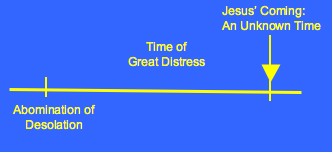
The Problem of a 3-1/2 Year-Long Great Distress
An apparent contradiction arises, however, which all views attempt to reconcile: On the one hand, Jesus said His return will be immediately at the end of the great distress. Some have concluded that the distress lasts precisely 3-1/2 years. Some texts appear to say it lasts for 42 months, or 1,260 days, which equates to 3-1/2 years in prophetic years (Rev. 11:2-3; 12:6). However, Jesus also said His return would be at a time at which �no one knows the day or hour,� thus, it cannot be 3-1/2 years from the abomination that causes desolation, or one could tell the exact day and hour. Thus, the problem:
a. Jesus� return is after the great distress, which is apparently 3-1/2 years.
b. Jesus� return is after the great distress, at an unknown time.
So, which is it? The solution may lie in a peculiar phrase used in Daniel and Revelation. Although some texts seem to assign the equivalent of 3-1/2 years in either days or months, other texts seem to state that the time of great tribulation will last for �a time, times, and a half a time� (Dan. 7:25; 12:7; Rev. 12:14). Confident that point �a� above must be true�that the great distress lasts for 3-1/2 years�many conclude that �a time, times, and a half a time� is precisely 3-1/2 years. However, this assumption is problematic for several reasons.
First, it ignores the Lord�s explicit statement that �If those days had not been cut short, no one would survive, but for the sake of the elect those days will be shortened.� Second, �it ignores �b� above, whereby Jesus� return must be at an unknown hour, and yet immediately follow the great distress. Third, the Greek word kairos used in Revelation 12:14 does not mean any specific length of time, per se.
So, how are points �a� and �b� reconciled?
A Possible Solution�The Pre-Wrath Rapture Model
Others (John Calvin, John Goldingay, Theodor F.D. Kliefoth, Carl F. Keil, et. al.)(1) have proposed that �a time, times, and a half a time� does not represent 3-1/2 years. Rather, it indicates a period that would seem to go on without end, and then will suddenly be ended�a perfect paraphrase of how Jesus described His return in Matthew 24, by the way. It is as if 3-1/2 years was granted to Satan during the great distress, but then God decides to cut it shorter than 3-1/2 years after all. Incidentally, Jesus said of that time:
�For then there will be great distress, unequaled from the beginning of the world until now�and never to be equaled again. If those days had not been cut short, no one would survive, but for the sake of the elect those days will be shortened� (Matt. 24:21-22).
So, the solution appears to be that, what was originally intended to last 3-1/2 years is shortened to a lesser amount. How short? Only God knows�Jesus� exact point:
“No one knows about that day or hour, not even the angels in heaven, nor the Son, but only the Father� (Matt. 24:36, NIV).
As for the length of the great distress in The Book of Daniel, Daniel himself was also told that he could not know its length,
5 �Then I, Daniel, looked, and there before me stood two others, one on this bank of the river and one on the opposite bank. 6 One of them said to the man clothed in linen, who was above the waters of the river, “How long will it be before these astonishing things are fulfilled?” 7 The man clothed in linen, who was above the waters of the river, lifted his right hand and his left hand toward heaven, and I heard him swear by him who lives forever, saying, “It will be for a time, times and half a time. When the power of the holy people has been finally broken, all these things will be completed.” 8 I heard, but I did not understand. So I asked, “My lord, what will the outcome of all this be?” 9 He replied, “Go your way, Daniel, because the words are closed up and sealed until the time of the end� (Dan. 12:5-9, NIV).
The reader should not be discouraged that the length of the great distress cannot be known; Jesus did not know how long it was, and Daniel was not able to discover its length, either. Rather, we should be encouraged, because the fact that we cannot know the length further ensures that Scripture lines up with other Scripture. You cannot know how long it will last, so that you cannot know when Jesus will return. Problem solved.
(1) For instance, see John Goldingay, f.n. 1; John Calvin, Commentaries on the Book of Daniel, trans. By Thomas Myers (Grand Rapids, MI: Eerdmans, 1948), 68; Carl F. Keil, Biblical Commentary on the Book of Daniel (Grand Rapids, MI: Eerdmans, 1949), 244; and Theodor F.D. Kleifoth, Das Buch Daniels (Schwerin: A.W. Sandmeyer, 1868), s.v. �Daniel 7:7,� cited in Keil, 244.
By Alan Kurschner
First, an Outline of the Prewrath Rapture
In this article I would like to make a case for the Prewrath Rapture and trust that you, the reader, will consider it thoughtfully and Biblically. I will be making my case by examining what are called the “Cosmic Disturbance” passages, which will be explained below. It is my contention that tracing this pivotal eschatological theme, the student of prophecy should grasp coherence and consistency of the key “end-time” Scriptural texts, as well as the events surrounding the immediate framework of our Lord’s Coming.
But in this first part, I want to say something about the Prewrath Rapture as a whole. The reason why this position is called “prewrath” is to stress the truth that believers are promised deliverance from the eschatological Day of the Lord’s wrath (1Thess 5, 1Thess1:10). But this is not the point of contention. This blessed promise is agreed by all viewpoints.
How is the Prewrath position distinctive vis-à-vis the traditional premillennial views such as pre-trib, mid-trib, and post-trib?
First, it begins with the fundamental truth that the “Great Tribulation” is initiated at the midpoint of the 7 year period, or what is commonly called the “70th week of Daniel” (Dan. 9:27, Matt. 24:15, 21-22). The Great Tribulation is in no way to be viewed as “God’s wrath,” but rather “Antichrist’s” wrath. The object of persecution during this time of great distress are believers—not unbelievers (Matt. 24:22).
In addition Jesus informs us that the Great Tribulation is “cut short” with his Coming. The “70th week of Daniel” is not cut short, but rather the persecution is cut short. When will this “cutting short” occur? We don’t know. Jesus says that no one knows the day or hour; but Jesus does place it after the midpoint after an unknown duration of time.
So to understand the distinctive position of the Prewrath rapture, it is important to distinguish two events:
1) The “Great Tribulation” which begins at the midpoint (the object of wrath are believers, the persecutor is an “Antichrist” figure); and after an unknown duration of time those days will be ‘cut short” with his Coming (Parousia).
2) The “Day of the Lord’s wrath” which will commence when Christ returns (the object of wrath will be the ungodly). After the Great Tribluation is cut short, the Day of the Lord’s wrath will be poured out for what remains left of the 70th week of Daniel.
One other point should be noted. Most would agree that on the same day when the Lord comes back and raptures the church and resurrects the dead, he immediately begins to pour out his Day of the Lord’s wrath. Just so that we do not make any unwarranted assumptions the following texts demonstrate this truth in which deliverance/judgment occur back-to-back on the same day (Luke 17:22-35, 2 Thess. 1:6-10, 2 Peter 3:12)
To recap, the Prewrath rapture view teaches that at the midpoint of the “70th week of Daniel” the “abomination of desolation” will initiate the Antichrist’s Great Tribulation (this is not God’s wrath; rather the object of persecution during this time will be the church, not the ungodly). Then according to Jesus, at some unknown duration or time (no one knows the day or hour) the Great Tribulation will be cut short (not the 70th week cut short, rather the Great Tribulation is cut short) with the Coming of Christ to deliver the righteous (rapture) and resurrection, then the subsequent Day of the Lord’s wrath against the ungodly will follow for what remains left of the 7 year period. (Click here for a comparison chart)
That is the contour of the Prewrath Rapture. Let us now consider if the Biblical evidence provides us with a strong, viable, defense for this perspective.
The Day of the Lord’s wrath
In most studies on end times and the rapture question, the default or the presupposition is to simply assume a timing of the rapture and then attempt to fit all the events (no matter how awkward) around that presupposed timing.
This is not fair to Jesus’ teaching, and it does not allow a natural reading of the flow of the events–further, it is indicative of someone protecting a traditional view without an openness to challenge one’s own viewpoint.
I will argue that the real question to ask is not the timing of the rapture, but the timing of the “Day of the Lord.” As will be demonstrated below, once the timing of the Day of the Lord is established, the rapture question is naturally answered.
By Steve McReynolds
People like simplicity. I know I prefer it. Place the issue of Jesus’ return in front of someone and ask them to tell you their view, and almost invariably they want to know, “What are my choices?” It’s a good place to start. Well-educated preachers are taught, when researching a passage of Scripture, to consult a commentary—good ones offer different options on what the Bible may mean. From there, the preacher has a baseline from which to begin and develop his own beliefs.
Considering what others have said is a good place to start, but not necessarily a good place to finish. What about the return of Christ? Probably, because we like simplicity and dislike ambiguity, we have managed to boil what must be thousands of variations down to just three views. Pretribulational, Mid-Tribulational, and Post-Tribulational made the cut. It reminds me of small, medium, and large; vanilla, chocolate, and strawberry, smoking or non-smoking, etc. You get the idea.
But let us remember: Where did these “options” come from—Pre, Mid, and Post? From the men who developed them. These theological options are not “God-breathed,” as Paul says the Bible is. Therefore, they may be a good place to start, but not necessarily a good place to finish.
We really are victims of our preference for simplicity. What if you worked at McDonald’s and somebody asked for a “medium and-a-half Coke?” They decided they wanted something between a medium and a large. “There’s no such thing,” you’d reply. Actually, there is such a thing as the ability to thirst for a different amount than McDonald’s idea of small, medium, or large. It’s just that McDonald’s is not prepared to handle that request.
Alright, what if somebody asked you to consider a view on a biblical topic that wasn’t one of the currently popular three views? Not “small, medium, or large?”—containers, by the way, invented and created by people, not God. Would you reject it, because it’s unfamiliar? What’s wrong with another size? Is it “wrong, because we haven’t done it that way before?” Are those three sizes automatically our only options, because that’s just the way we do it nowadays?
Well, Starbucks doesn’t think so. Try ordering a “medium coffee” there. Furthermore, there were no “small, medium, and larges” in Moses’ day, or Jesus’, and most likely not one hundred years from now, either. Are you getting the point that there is nothing “magical” about “small, medium, and large?” Medium is a size of beverage, but it isn’t the only size, nor is it one of three only sizes. On the same token, there is nothing “magical” about Pretribulational, Mid-Tribulational, and Post-Tribulational. These are popular views, simply because they’re popular. Granted, they each have their own merits. But stronger arguments may favor “another size”—“a medium and-a-half,” if you will.
What if another “size” was proposed—another explanation of Christ’s return? Is it automatically wrong because it isn’t one of the “three?” If it is, then stop shopping at Starbucks.
By Steve McReynolds
“Are you open to feedback?” This is the question that, as a counselor, I have asked hundreds of clients in my practice. In other words, “Do you know everything there is to know about yourself, or is there a possibility that there are some things you aren’t aware of, which might help you improve?” I can tell the person’s attitude by their answer. If they say yes, the counselor or other peers will give them feedback. If not, there’s really no point in going on, is there?
This question can be asked of anyone about their views on the return of Christ: “Are you open to feedback?” If a person says, “Yes,” then they are committing themselves to listening and being patient. They are allowing themselves to say, “I’m not sure about this particular point. I might actually have been mistaken. I can improve my knowledge.”
“Are you open to feedback?” As a counselor I realize that this question relates to security and insecurity. A healthy attitude to have about debatable issues is to say, “This is what I believe. I could be wrong, or I might need to adjust my belief. I can always benefit from a different perspective.”
Some people are insecure about their beliefs. They just believe it, because someone they trusted told them. Their roots are not that deep. It has not become personally their own. Therefore, when someone offers another perspective on a particular belief of theirs, they feel threatened. They don’t know how to respond, because they haven’t actually done the work of studying. Others feel insecure, because they take the interaction personally: “You’re suggesting I might be wrong. I don’t like to be wrong. If I’m wrong about this, what if I’m wrong about something else? That would scare me.”
So, what about you? “Are you open to feedback?” When someone offers a different perspective on a biblical idea, do you find yourself becoming angry? Afraid? Do you say things against the person? Do you feel uncomfortable and wish you could leave the room? These are all common reactions that come when a person feels threatened. If you find yourself doing this, ask yourself, “Why do I feel threatened right now?”
A person who is open to feedback is never threatened by new ideas. They live their lives with an open mind, expecting that they can improve themselves by listening to others. They know they don’t know everything, and they’re o.k. with that. Are you o.k. with that?
What we all must accept is that none of us are expected to have a 100% corner on the truth, unless your name is God. And that’s o.k. The basic fundamentals of the faith are not negotiable: The virgin birth, the deity of Christ, etc. But there are issues in which the Bible leaves room to clarify.
If you’re open to feedback, you may benefit from the following discussion. Some verses of Scripture may finally begin to make sense—or better sense—to you. You may feel like you have a better perspective on the issue. But all of this depends on your answer:
“Are you open to feedback?”